

Foundation, programs and governing principles
“Go  therefore and make disciples of all nations.”
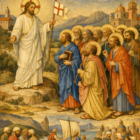
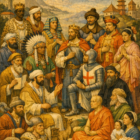
— Matthew 28:19
The generous gift of self and the call to holiness
The primary guiding principle of the ministry is the generous giving of self on the part of the evangelizer. This generosity flows from the wondrous realization that God Himself entered our world; that the very earth we walk was walked by the God-Man; and that He has personally called us to follow Him.
The evangelizer must lift his eyes in love and wonder to heaven, where Christ has gone and from where He calls us to Himself. At the same time, he must return his gaze to the world, continually renewed by the vision of Christ’s love encountered in the Eucharist. From this vision flows the call to pour oneself out generously for the salvation of souls.
The response demanded by such love cannot be partial. It is all or nothing. Our response must be as radical as the love to which we respond.
Flowing from this is our first responsibility: a promise of fidelity to the Church. This includes fidelity to all her teachings and respect for her leaders. Evangelizers must obey the directives of their spiritual director, trusting his prudential judgment in their undertakings. They must also obey the local ordinary of any diocese in which they function and respect and obey the directives of every priest in whose parish they work
Such obedience is not incidental; it is necessary for the spiritual good of both evangelizers and those they serve.
Closely united to this is the commitment to struggle for personal holiness. Nothing we do can bear good and lasting fruit unless we ourselves are striving to become holy after the image of Christ. Evangelizers must never become complacent in mortal sin or even in venial sin, but must continually seek purification through the sacraments.
By living a sacramental life and pursuing holiness, evangelizers come to taste the power and sweetness of the Lord whom they proclaim. Only then can they testify authentically to Him, allowing the light of God to shine more clearly through their lives to those they encounter.
This foundation governs every program, method, and decision of the ministry.
RENEWAL OF PARISH LIFE
through eschatological hope and joyful formation
The loss of the Catholic spirit in society can, in my view, be traced in large part to the loss of the eschatological character of parish life.
When the faithful no longer live as a people of hope, watchful and expectant for the coming of Christ, the parish is easily reduced to little more than a social gathering, rather than a place where the Lord comes to meet His people and where their hope for His final coming is renewed. As this outlook fades, Christians are tempted to see the world as their home, directing their deepest longings and hopes earthward instead of heavenward, and in this way the supernatural horizon of the Christian life gradually collapses.
Through this ministry, we seek to contribute to a renewal of this great outlook that characterized the early Church. For this reason, we do not seek merely to teach catechism classes through Know Your Faith (KYF) circles, ordinary parish catechesis for children, or theological seminars. Rather, we aim to teach the faith with the zeal, joy, and urgency that the Gospel itself demands, presenting doctrine not as dry information but as living truth—truth that shapes how Christians pray, suffer, hope, and live.
SUM AND SUMMIT
Sacrament-centered evangelization
Every activity of the ministry must point toward an encounter with the Lord in the sacraments. All invitations, whether through teaching, media, publications, or outreach, must ultimately lead people to Christ present and active in His Church, especially in the Eucharist and in Confession.
We believe that helping people develop a personal and communal relationship with Jesus Christ in the sacramental life of the Church is the heart of evangelization, for those who are drawn into a deep and loving relationship with Christ in His Church are on the surest path toward heaven and make real progress in sanctity.
Teaching, media, and outreach must therefore help people understand what the sacraments are, why they matter, and how to receive them fruitfully, since the goal is not mere attendance or familiarity, but conversion expressed through repentance, reverence, and perseverance. For evangelization to be complete, it must lead beyond information to attraction, and beyond instruction to a re-ordering of life around Christ. As expressed elsewhere:
“Until your entire life is pulled toward Christ in the Eucharist, the way every planet and comet is pulled by the sun to keep the whole solar system in order, formation remains incomplete. The Eucharist becomes the sun of your life, drawing you to Himself, consuming you, transforming you into fire, and restoring order in the universe of your soul.”
— Kenneth C. Alimba, Consumed: Nature and Movements of a Heart on Fire
In this way, the Eucharist stands at the center of Christian life, not as one devotion among many, but as the living presence of Christ who orders, sustains, and transforms the whole of human existence.
FORMATION
of children, teenagers, and young adults
The ministry will design formation programs for children, teenagers, and young adults, recognizing that each group requires a distinct approach.
Children are formed through rich illustrations and visual materials that cultivate imagination, reverence, and love for the sacred. Teenagers and young adults receive similar visual formation but with greater clarity in explanation, deeper reasoning, and structured activities such as games and discussions that challenge them intellectually.
At this stage, young people should begin to be formed consciously for mission, whether toward priesthood, religious life, or marriage. Where possible, they are gently introduced to elements of Catholic philosophy to strengthen their ability to think clearly and responsibly.
CAST INTO THE DEEP
Media evangelization
The ministry engages modern media deliberately and intelligently.
Online platforms are used to open doors, start conversations, and invite deeper engagement with the Catholic faith.
Scheduled, purposeful, and content-driven programs are conducted through platforms such as TikTok and Facebook Live. These programs aim to spread Catholic culture, engage both Catholics and non-Catholics, and draw people toward the sacraments and the desire for holiness.
We must resist the temptation to seek media growth as an end in itself, or to gauge results by engagements received. Indeed, we must resist the temptation to measure results altogether, entrusting all fruit to God alone. Our task is to discharge each responsibility with diligence and fidelity, always reminding ourselves that, having done all that is commanded of us, we can only say:
“We are unprofitable servants”
— Luke 17:10
LITERARY TREASURES OF THE CHURCH
Publications and printed material
The ministry will produce books, manuals, tracts, and illustrations that explain and defend the Catholic faith in an accessible and engaging manner.
These include practical guides for Confession and Holy Communion, catechetical materials, and visual explanations of aspects of the faith.
Printed materials allow the faith to be encountered slowly and reflectively, without dependence on screens. All publications are faithful to Catholic teaching and draw from Scripture, the saints, the Fathers of the Church, the popes, and the vast literary treasury of the Church handed down through two thousand years.
Outdoor and public evangelization
The ministry seeks a visible presence beyond classrooms and screens.
This includes the use of canopies in selected parishes, depending on available manpower, as well as special programs in schools and other appropriate public spaces.
Public evangelization will be conversational, invitational, and calm. Its purpose is not argument or disputation, but encounter, inviting people to take Christ, His Church, and the life of faith more seriously.
Charity and works of mercy
Charity is an essential aspect of the ministry’s work.
Through charity, evangelizers live out the radical love for the poor preached by Christ and encounter Him in those they serve.
Faith without works is dead. Charity prevents the ministry from becoming abstract or one-sided and helps ensure a balanced witness. As resources permit, the ministry seeks to assist those within its immediate reach by feeding the hungry and caring for health needs when possible.
Formation of evangelizers
Those who serve as evangelizers must be continually formed. They must love the Lord, desire to know His truth, and maintain an active prayer life.
Evangelizers should possess at least a basic understanding of the faith and remain open to ongoing learning. They must carry the image of the Church as a mother, approaching others with patience, attentiveness, and genuine care.
Formation includes active participation in KYF circles, cultivation of spiritual discipline, and unwavering obedience to Church teaching. Without this, no one may represent the ministry.
Public evangelization will be conversational, invitational, and calm. Its purpose is not argument or disputation, but encounter, inviting people to take Christ, His Church, and the life of faith more seriously.